
One connected platform built around your operation
Connect people, equipment, workflows and operational knowledge in one configurable system.
AdunniTrak brings operations, downtime, maintenance, reliability, inventory, workforce activity, administration and operational reporting into one connected environment. The platform is configured around your facility structure, equipment hierarchy, workflows, responsibilities and operational terminology, while Adunni AI provides an authorised intelligence layer across relevant areas of the system.
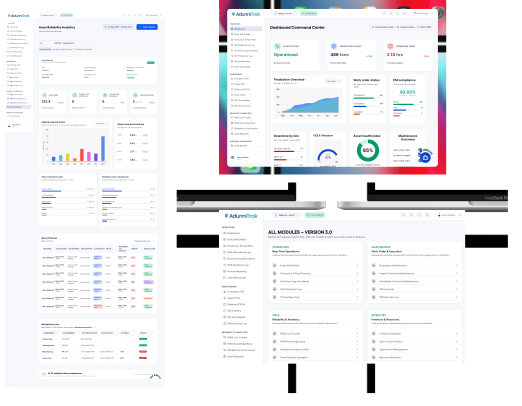
Configured around the way your plant works
Industrial facilities differ in structure, equipment, responsibilities, terminology and operating priorities. A steel plant does not operate like a quarry, a power facility or a processing plant. AdunniTrak provides a common platform structure that can be configured to reflect those operational differences.
Facility structure
Sites, plants, departments, areas, lines and teams.
Equipment hierarchy
Equipment, sub-equipment and approved asset relationships.
Terminology
Names, classifications, priorities and expressions.
Roles
Access, responsibilities, escalation and approvals.
Workflows
Operational steps, validations, priorities and controls.
Reporting
Operational, technical, supervisory and leadership views.
Integration
Approved connections based on need and available interfaces.
Not generic. Not completely bespoke. A structured platform configured around the organisation.
Every operational domain contributes to a shared view
AdunniTrak connects the activities and information required to understand what is happening, coordinate what needs to happen next and preserve what the organisation learns over time.
Operations
Daily operational activity, production, downtime, shift communication and field reporting.
Maintenance
Priority-based work, planned tasks, preventive maintenance, safety validation and execution history.
Reliability & Analytics
Performance metrics, failure analysis, asset reliability, FMEA investigation and organisational learning.
Inventory & Resources
Parts, store locations, stock receipts, stock issues, availability and resource visibility.
Workforce & Administration
Employee structure, shift assignment, attendance, team coordination and authorised administration.
System & Support
Configuration, access control, system overview, support, settings and approved integration management.
The value of the platform comes from these domains working together. Information should not have to be recreated every time work moves between teams.
Follow one operational event across the platform
A connected platform becomes most useful when information follows the work. The example shows how one equipment event progresses through AdunniTrak.
Supporting domains
Inventory information supports parts availability. Workforce records establish responsibilities and shift context. Adunni AI helps authorised users locate similar failures and prepare structured summaries.
Production or operational event
A shift team records the operating condition, performance impact or equipment event.
Failure detected
The event is formally marked as detected in the downtime log, establishing the detection point and supporting MTTD.
Incident acknowledged
An authorised supervisor, planner or reliability representative acknowledges the incident, supporting MTTA.
Maintenance response
The issue is routed into the appropriate P1, P2, P3 or P4 workflow with responsibilities, work information and required safety controls.
Repair execution
Authorised personnel start and complete the repair. The recorded repair window supports MTTR.
Root cause investigation
Where investigation is required, the event moves into FMEA Live. Confirming the root cause supports MTTI and preserves the approved finding.
Reliability learning
Confirmed causes, recurring patterns and asset history contribute to reliability analysis and future preventive action.
Reporting and improvement
Operational and leadership teams review the event, response, outcome and related improvement actions.
Industrial intelligence connected to operational context
Adunni AI is an intelligence layer within the AdunniTrak platform. It works with relevant information already structured and authorised within the client's environment rather than providing generic responses disconnected from plant reality.
Potential authorised context
How Adunni AI may support teams
Adunni AI operates within defined user permissions and authorised information boundaries. It supports professional judgement and approved workflows; it does not replace operational responsibility, engineering judgement, safety procedures or required approvals.
A shared operational view with role-based access
The Command Centre brings relevant operational information together while role-based access helps ensure users see and perform the activities authorised for their responsibilities.

Frontline Operators
Record activity, report events, provide evidence and support shift continuity.

Shift Supervisors
Review production, downtime, workforce activity, open issues and handover.

Maintenance Teams
Receive work, validate safety requirements, execute repairs and record completion.

Reliability Engineers
Review performance, investigate failures, confirm causes and preserve learning.
Inventory & Stores Managers
Manage item information, locations, receipts, issues and stock availability.

Plant Managers
Monitor plant status, performance, open risks, maintenance and priorities.

Executive Leadership
Review approved summaries, trends, organisational performance and priority risks.

IT & System Administrators
Manage authorised access, configuration, system support and technical requirements.
Foundations that support connected industrial work
Connected operational records
Link related production, downtime, maintenance, reliability, inventory and workforce information into a traceable history.
Shift-to-shift continuity
Carry unresolved issues, updates and responsibilities forward so context is not lost between teams.
Mobile and desktop access
Support approved operational activity and visibility from suitable desktop and mobile interfaces.
Picture and evidence reporting
Capture approved field photographs and supporting evidence directly within relevant workflows.
Role-based access
Provide information and actions according to authorized responsibilities.
Workflow and approval controls
Use defined steps, required validations and approval points to support accountable execution.
Notifications and escalation
Inform the appropriate users when attention, acknowledgement, action or review is required.
Operational audit history
Preserve timestamps, actions, updates, approvals and workflow history for traceability.
Structured reporting
Turn connected records into clear shift, maintenance, reliability and leadership information.
Multi-site configuration
Support organisations that require separate site structures with appropriate consolidated oversight.
Integration-ready architecture
Support approved connections with existing business, operational or monitoring systems.
Organisational knowledge retention
Preserve confirmed operational experience and learning so it remains accessible to authorised teams.
A structured implementation approach
Implementation scope, sequence and technical requirements depend on the selected modules, facility complexity, existing information and agreed deployment approach.
Understand the operation
Review facility type, operational areas, priorities, challenges and intended outcomes.
Map the facility and equipment
Capture the agreed plant structure, departments, lines, equipment hierarchy and local names.
Confirm workflows and responsibilities
Document how information, incidents, work, approvals and handovers move between roles.
Configure modules and terminology
Align the relevant AdunniTrak domains with processes, priorities and nomenclature.
Review security and integration
Engage operational, IT, OT and cybersecurity representatives to confirm requirements.
Validate with client teams
Review the configured environment with users and stakeholders before deployment.
Deploy, support and improve
Introduce the agreed scope, support users, monitor adoption and refine configuration.
Operational intelligence within defined boundaries
Industrial information must be available to the people who need it without becoming unrestricted. AdunniTrak is designed around authorised roles, defined workflow responsibilities and traceable operational activity.
Hosted infrastructure
Cloud or private hosting structured around client technical, operational and compliance requirements.
Authorised access
Identity management, multi-factor authentication (MFA) and single sign-on (SSO) integration options.
Role-based permissions
View, edit, approve and administer permissions linked to verified operational roles.
Auditability
Traceable records of data entry, approvals, modifications and system configuration changes.
Data management
Automated backups, retention policies and controlled procedures for information management.
System integration
API connections to approved external systems (e.g., ERP, SCADA) based on operational need.
Important qualification
Specific hosting, encryption, compliance, integration and cybersecurity requirements must be confirmed during technical assessment. This website does not display certifications or guarantees that have not been formally verified.
Understanding how AdunniTrak works
No. AdunniTrak provides a structured platform that is configured around the client's facility, equipment hierarchy, workflows, roles, priorities and terminology.
No. The core platform and connected domains already exist. The relevant structure, modules, terminology, permissions and workflows are configured to reflect the client's requirements.
Each domain supports a specific responsibility, but the platform is designed so related information can move across authorised workflows and contribute to one operational history.
No. Adunni AI is designed to work within authorised AdunniTrak context and client-specific operational terminology.
Potential integrations are assessed individually based on the required purpose, available interfaces, data ownership, security requirements and agreed implementation scope.
Yes. Approved terminology, naming structures and operational classifications can be configured to reflect each organisation or facility.
No. Access and permitted actions are defined according to authorised roles, responsibilities and organisational boundaries.
The platform can be structured for multiple sites or facilities, subject to the agreed configuration, access and implementation requirements.
The scope is established through operational discovery, facility and equipment mapping, workflow confirmation, security and integration review, configuration, validation and deployment planning.
Ready to connect your industrial operations?
Tell us about your facility, workflows and operational priorities. We will show you how AdunniTrak can be configured to support your teams.